FRAMEWORK
The Nelson Engagement Framework
The behavioral foundation of Peace Innovation
The Nelson Engagement Framework is the origin framework behind the Peace Innovation Lab’s work.
Developed by Mark Nelson early in the Lab’s history, the framework gives Peace Innovation its central behavioral claim: peace is not simply the absence of war, violence, or conflict. Peace is something people and systems do. It appears in repeated, observable, prosocial engagement across difference — especially when that engagement produces mutual benefit and becomes capable of sustaining itself over time.
The framework asks a practical question:
How does engagement move from fragile contact to self-sustaining collaboration?
Nelson’s framework maps peace across two dimensions: the quantity of engagement and the quality of engagement. It distinguishes destructive or degrading engagement from positive engagement, and it identifies the threshold where cooperation becomes collaboration — the point at which engagement begins to create surplus cooperative capacity.
This framework predates and grounds many later Peace Innovation Lab frameworks, including the Peace Data Standard, Peace Canvas, Peace Specs, Peace Engineering, Peace Finance, and Peace Debt.
The founding question
The Peace Innovation Lab began with a deceptively simple question:
How good can we be to each other?
The Nelson Engagement Framework turns that question into an analytical model.
It does not treat peace as sentiment, harmony, diplomacy, or aspiration. It treats peace as a behavioral phenomenon: a pattern of interaction that can be designed for, measured, tested, strengthened, and scaled.
The framework begins with the Lab’s foundational definition:
Peace is not the absence of war. Peace is a suite of positive, prosocial behaviors that maximize mutually beneficial outcomes from interactions with others.
Under this definition, peace is not passive. It is not an ambient condition that appears when violence stops. Peace is enacted through engagement: who reaches across which boundary, under what conditions, with what behavior, with what result, and whether the interaction makes the next positive interaction easier or harder.
From Galtung to Nelson
The framework translates positive peace into measurable engagement.
The Nelson Engagement Framework builds on the positive and negative peace distinction associated with Johan Galtung.
Negative peace refers to the absence, reduction, or prevention of violence. Positive peace refers to the presence of constructive relationships, social conditions, and mutually beneficial interaction. The Peace Data Standard paper uses this distinction and then makes the Peace Innovation Lab’s behavioral move: peace is defined as positive, prosocial behaviors that maximize mutually beneficial outcomes from interactions with others.
Nelson’s contribution was to operationalize this distinction through engagement.
In the Nelson Engagement Framework:
Negative peace is the zero line.
Reaching the zero line may stop loss, reduce harm, or stabilize conflict. But it does not create net new value.
Positive peace begins above the zero line.
Constructive engagement begins to produce value through awareness, attention, communication, coordination, and cooperation.
Sustainable positive peace begins above the engagement threshold.
When cooperation becomes collaboration, engagement can begin producing surplus cooperative capacity that can be reinvested into the next round.
This is the central investment thesis of the framework:
Negative peace contains damage. Positive peace creates capacity.
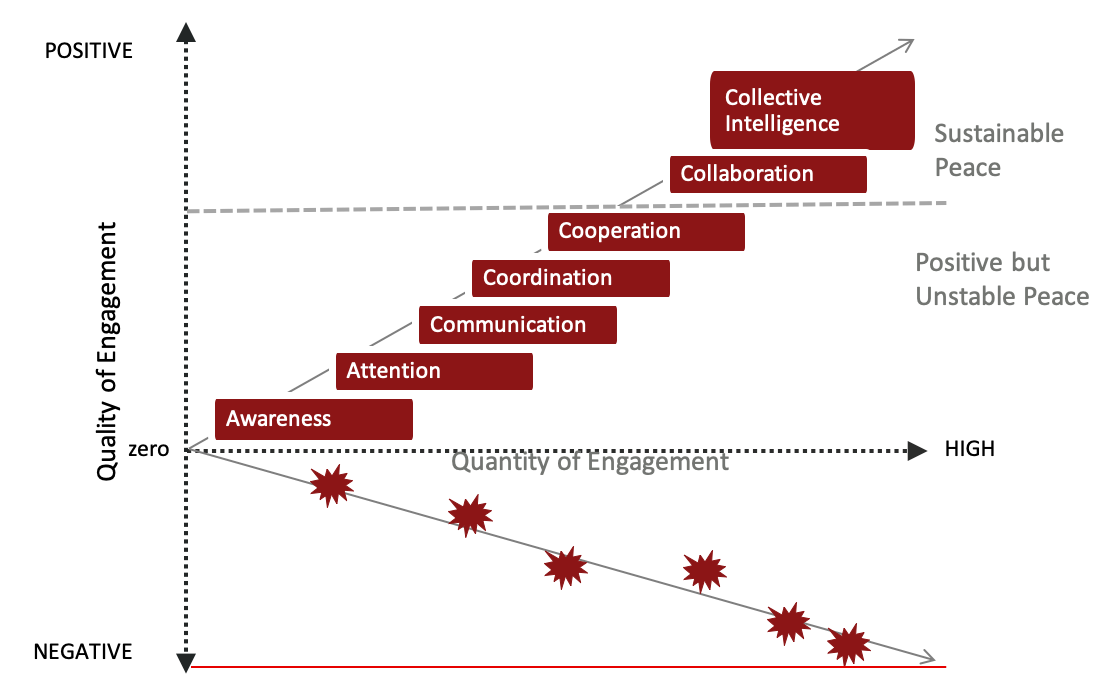
Original engagement framework diagram created by Mark Nelson in the early 2010s. The diagram maps peace behaviorally across two dimensions: quantity of engagement and quality of engagement.
ORIGINAL DIAGRAM
Engagement Framework
This early diagram shows the framework’s original structure: engagement can increase or decrease in both quantity and quality. The zero line separates destructive engagement from positive engagement. The upper threshold marks the point where cooperation becomes generative collaboration.
The rest of this page explains the model in accessible prose and simplified diagrams.
The positive peace blind spot
Conflict reduction is necessary. But in the Nelson Engagement Framework, reducing conflict moves a system toward the zero line. It may stop loss, prevent destruction, or stabilize a crisis, but it does not by itself create net new value.
A system at the zero line may be quiet, stable, or nonviolent. But it has not necessarily developed the trust, shared risk, collaboration, or collective intelligence required for sustainable positive peace.
This is the positive peace blind spot: peace work has become highly developed around conflict reduction, but less developed around positive peace production — how mutual benefit is created, how cooperative capacity compounds, and how collaboration generates surplus value.
The underdeveloped frontier of peace is not conflict reduction. It is positive peace innovation.
“Getting to zero stops loss. It does not create the future.”
The value logic of the framework
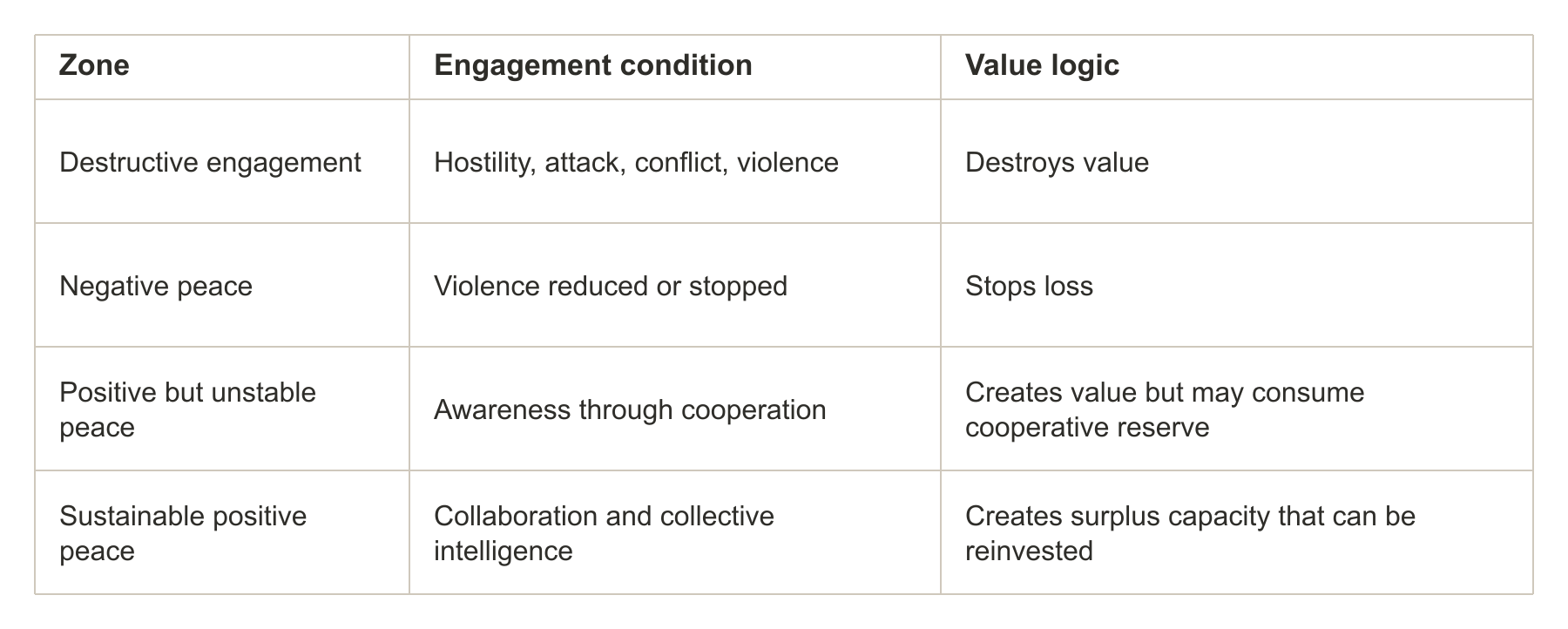
The value logic of the framework has four zones.
Destructive engagement destroys value.
Negative peace stops loss.
Positive but unstable peace creates some value but may consume cooperative reserve.
Sustainable positive peace creates surplus cooperative capacity that can be reinvested into future collaboration.
The Engagement Spectrum
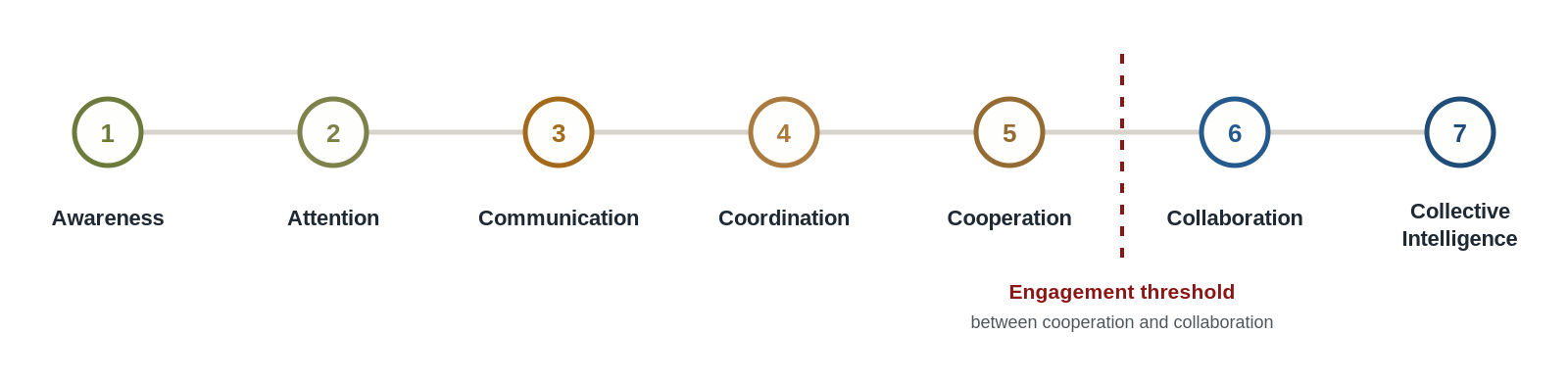
The Nelson Engagement Framework maps engagement across seven levels.
Awareness: parties know the other exists.
Attention: one party begins to register information about the other.
Communication: information moves between parties.
Coordination: parties align actions without fully integrating goals.
Cooperation: parties work toward shared goals while maintaining distinct interests.
Collaboration: parties integrate effort and share risk above the engagement threshold.
Collective intelligence: the system produces insight or capability no party could produce alone.
Engagement Threshold
Above the threshold
Self-sustaining and generative. Engagement creates surplus cooperative capacity that makes future interaction easier.
Below the threshold
Positive but unstable. Engagement may create value, but it depends on favorable conditions and may consume cooperative reserve.
Minimum Viable Peace
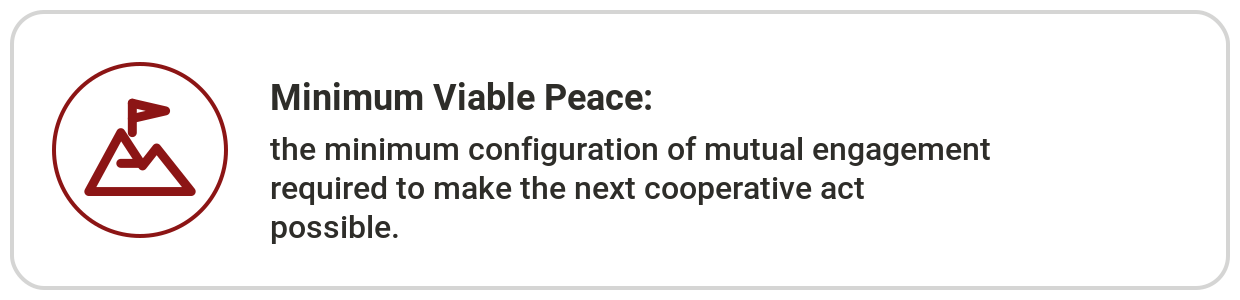
Minimum viable peace is the cooperative floor below which the next constructive interaction becomes difficult to initiate. It is not harmony, trust, or reconciliation. It is the minimum configuration of mutual engagement required to make the next cooperative act possible.
Are we managing a cooperative relationship, or rebuilding one from near-zero?
Mirror Trajectory
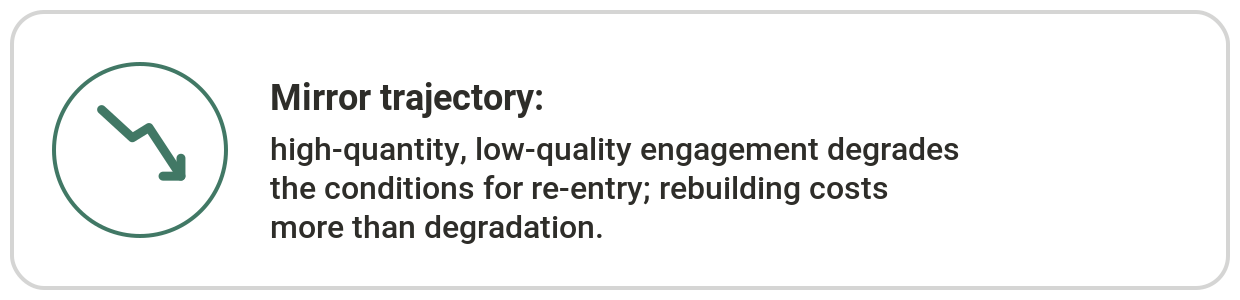
The mirror trajectory is the path by which engagement degrades.
High-quantity, low-quality engagement can damage the conditions required for future cooperation. Each harmful exchange raises the cost of re-entry and makes future positive engagement harder to trust.
More engagement is not the same as positive engagement.
The question is whether interaction increases or decreases the system’s capacity for future mutual benefit.
Why difference matters
The Nelson Engagement Framework rests on a structural insight:
Positive-sum exchange requires difference.
Identical actors have little to offer each other. Generative cooperation depends on parties being meaningfully different — in knowledge, perspective, resources, position, experience, context, or capability.
Difference is not incidental to peace. It is the raw material of mutual value creation.
This reframes diversity. Diversity is not only a moral, cultural, or representational good. It is also a structural condition for innovation, learning, resilience, and positive-sum exchange.
When systems eliminate difference in the name of efficiency, standardization, consolidation, or control, they may also eliminate the conditions under which new value can be created.
From engagement to later PIL frameworks
The Nelson Engagement Framework is the root framework behind several later Peace Innovation Lab frameworks. PeaceDot demonstrated early measurement of engagement across difference. The Peace Data Standard formalized measurement. Peace Canvas supports applied design. Peace Specs translates desired peace outcomes into requirements. Peace Engineering and Peace Finance apply the framework to built systems and capital systems. Peace Debt extends the framework into an analysis of what happens when cooperative capacity is extracted but not replenished.
Why the framework matters now
AI systems, digital platforms, workplaces, cities, financial systems, and political institutions all shape engagement.
They influence who notices whom, who responds to whom, who trusts whom, who avoids whom, who collaborates with whom, and who benefits from interaction.
The Nelson Engagement Framework gives designers, researchers, executives, engineers, civic leaders, and policymakers a way to ask a more precise question:
Is this system increasing the quality and durability of positive engagement across difference, or is it quietly degrading the conditions for future cooperation?
That question is central to Peace Innovation.
It moves peace from aspiration to design problem. It moves engagement from activity metric to structural diagnostic. And it helps identify the threshold where cooperation becomes capable of sustaining itself.
Framework Definition
The Nelson Engagement Framework is a foundational Peace Innovation Lab framework developed by Mark Nelson. It defines peace behaviorally as repeated, observable, prosocial engagement across difference boundaries that maximizes mutually beneficial outcomes. The framework maps engagement from awareness, attention, communication, coordination, and cooperation to collaboration and collective intelligence. Its central contribution is the engagement threshold between cooperation and collaboration, where interaction becomes self-sustaining and generative.
Attribution
The Nelson Engagement Framework was developed by Mark Nelson and should be attributed to him as the originating author. Peace Debt is an applied analytical extension developed jointly by Mark Nelson and Margarita Quihuis.