

STANDARD
Peace Data Standard
A practical and theoretical framework for using technology to examine intergroup interactions.
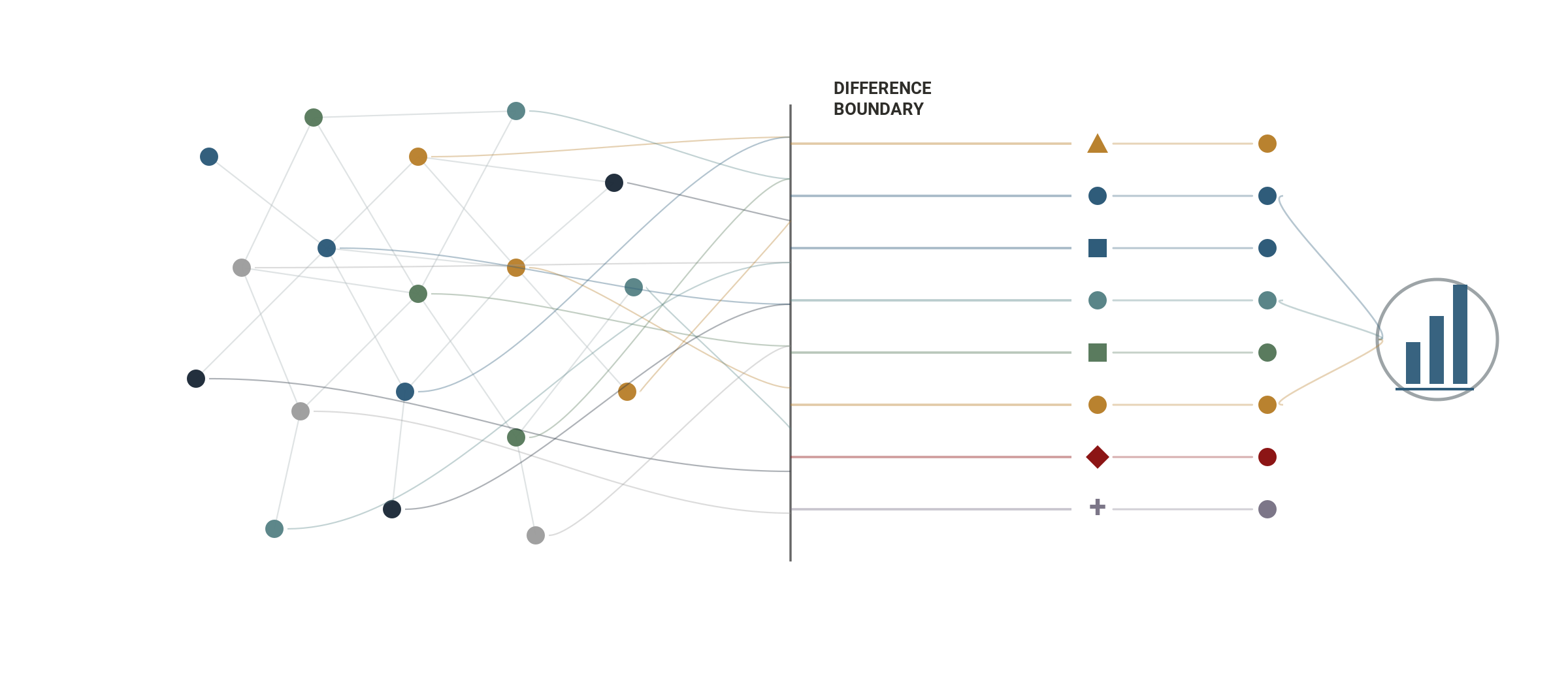
The Peace Data Standard provides a common framework for identifying and measuring positive engagement across difference boundaries—in the moment and over time.
Why This Matters
Capital markets struggle to assign value to peace, making it difficult to invest in what builds strong, healthy societies. Without shared metrics, companies can't demonstrate social impact and investors can't compare it.
The Peace Data Standard creates a common reference for measuring and reporting positive peace—enabling better decisions for businesses, investors, and communities.
What The Standard Is
The Peace Data Standard is a data framework and format that captures positive engagement across difference boundaries. It enables anyone using technology to measure peace impact in real time and over time.
How Peace Becomes Data
A simple model for moving from everyday interaction to measurable positive peace.
Find Your Starting Point
Field Guide
Explore the framework, principles, and applications.

Peace Canvas
A one-page tool to map and design your peace impact.
Implementation Toolkit
Download the Peace Data Standard Implementation Toolkit for worksheets, checklists, and templates to help you apply the standard in practice.

GROUNDED IN PUBLISHED RESEARCH
Guadagno, R.E., Nelson, M., & Lee, L. (2018). Peace Data Standard: A Practical and Theoretical Framework for Using Technology to Examine Intergroup Interactions. Frontiers in Psychology, 9:734.
The paper introduces a theoretical framework for identifying, collecting, structuring, and evaluating data about mutually beneficial engagement, while addressing ethical considerations and future research directions.
Developed through Peace Innovation Lab research on positive engagement, technology mediated interaction, and peace technology.
Frequently Asked Questions
-
The Peace Data Standard is a framework from the Peace Innovation Lab at Stanford for identifying, structuring, and evaluating data about positive engagement across difference boundaries.
It helps organizations measure peace as observable behavior: communication, response, reciprocity, repair, collaboration, trust-building, inclusion, and mutual benefit between people or groups.
-
The standard helps identify whether interactions across difference boundaries are producing positive engagement.
It can be used to examine signals such as who initiates contact, who responds, how often interaction repeats, whether engagement becomes reciprocal, whether relationships strengthen over time, and whether the interaction creates mutual benefit.
-
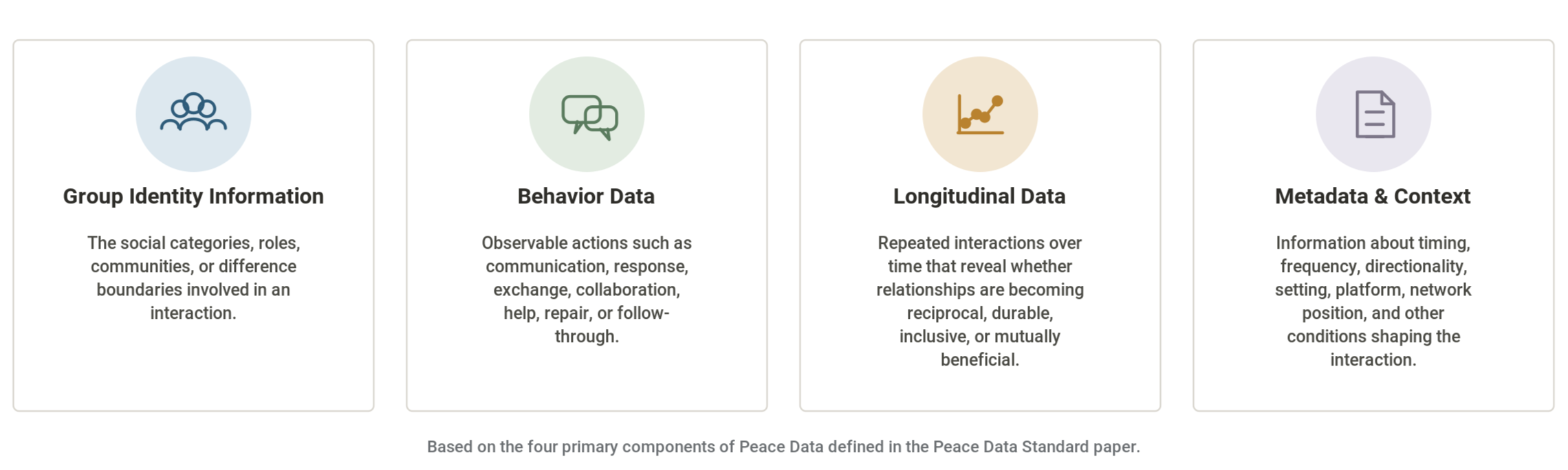
The four dimensions are:
Group Identity Information — the groups, roles, communities, or difference boundaries involved in an interaction.
Behavior Data — observable actions such as communication, response, exchange, collaboration, help, repair, or follow-through.
Longitudinal Data — repeated interactions over time that reveal whether relationships are becoming more reciprocal, durable, inclusive, or mutually beneficial.
Metadata & Context — information about timing, frequency, directionality, setting, platform, network position, and other conditions shaping the interaction.
-
A difference boundary is a social, cultural, institutional, demographic, geographic, political, professional, or identity-based distinction that shapes interaction between people or groups.
Examples include nationality, religion, gender, race, ethnicity, language, class, political identity, role, organization, team, discipline, or geography.
-
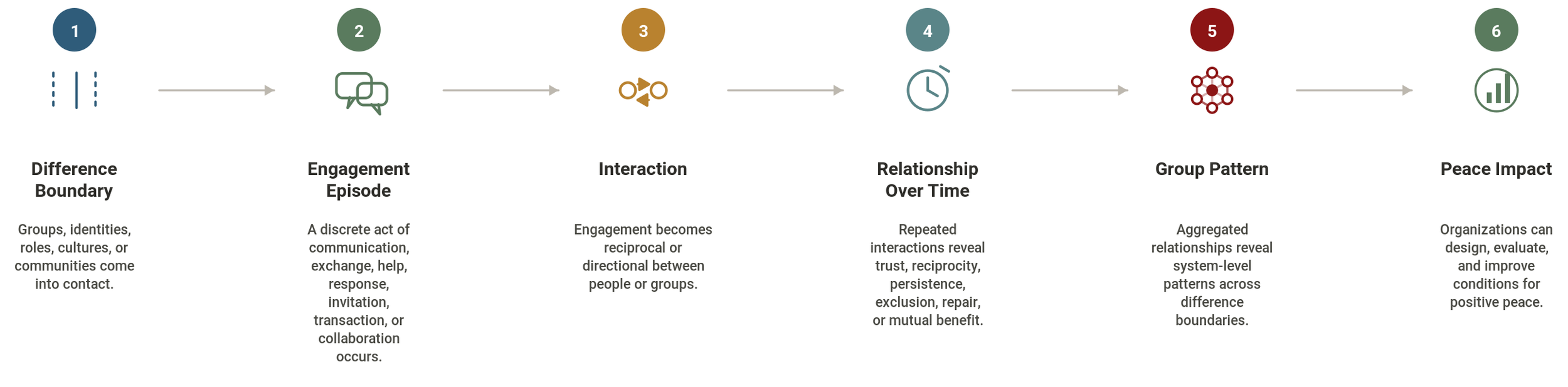
Peace becomes data when observable engagement across a difference boundary can be identified, structured, and evaluated over time.
The basic sequence is:
Difference Boundary → Engagement Episode → Interaction → Relationship Over Time → Group Pattern → Peace Impact
-
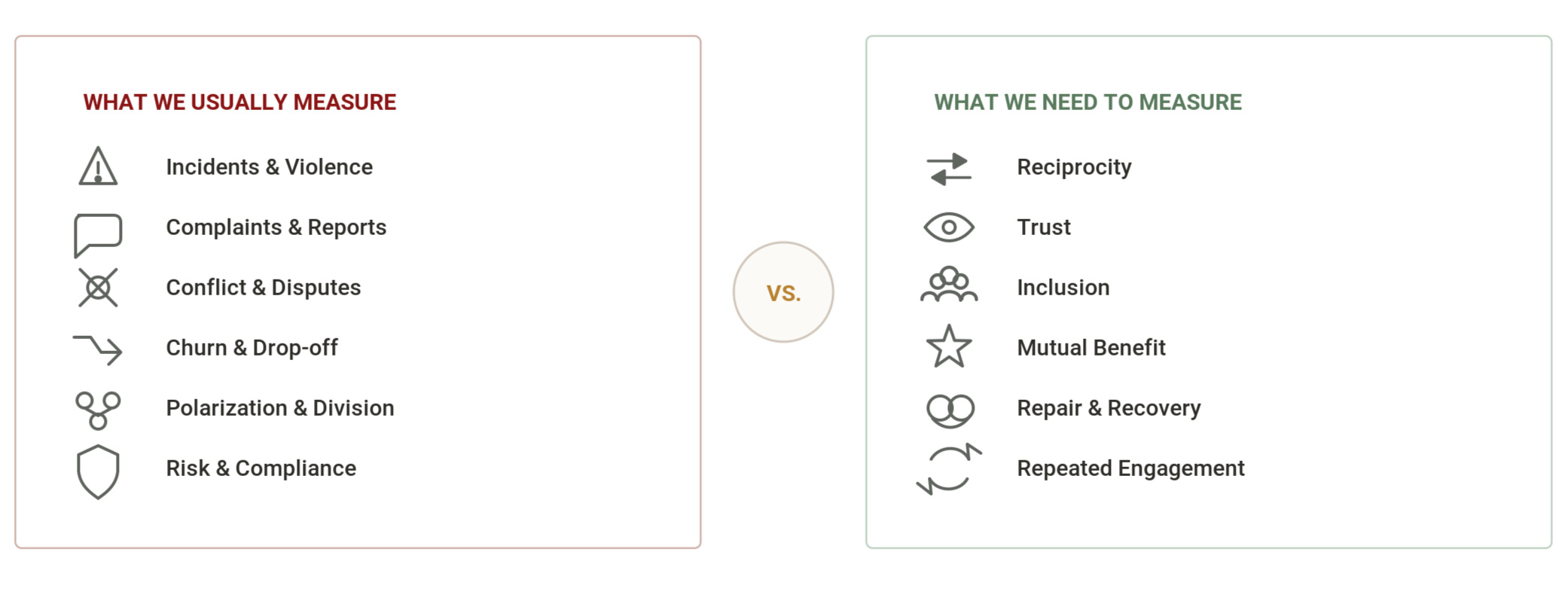
Conflict data usually measures harm, violence, complaints, incidents, risk, polarization, or breakdown.
Peace Data measures constructive interaction: trust, reciprocity, inclusion, collaboration, repair, repeated engagement, and mutual benefit. It helps organizations see where positive peace is being created, not only where harm is occurring.
-
Most organizations are better at measuring problems than measuring positive social value. They can count incidents, complaints, churn, violations, and risk, but often lack a way to identify constructive cross-boundary engagement.
The Peace Data Standard helps make positive peace visible, measurable, and designable.
-
The standard can be used by researchers, product teams, foundations and funders, governments and civic institutions, peacebuilding organizations, social impact organizations, and technology platforms.
It is especially useful for organizations that already generate interaction data but have not yet interpreted that data through a peace or positive engagement lens.
-
Peace Dot / peace.facebook was an early collaboration between the Stanford Persuasive Technology Lab, the Peace Innovation Lab, Facebook, and other technology partners to measure peace on the internet.
The project tracked daily friending activity across geographic, political, and religious difference boundaries. It demonstrated that positive cross-boundary engagement could be counted, visualized, and studied over time.
-
Within the broader Peace Innovation Lab architecture, the Peace Data Standard is the measurement layer.
Peace Canvas helps teams design for positive engagement. A Pattern Language for Peace describes recurring design patterns. Peace Engineering frames the field-level practice of designing systems that make positive peace easier to produce, measure, and sustain.
The Peace Data Standard provides a common language for designing, measuring, and comparing positive engagement across contexts.