PeaceDot
PeaceDot: Measuring Peace with Technology
A Case Study in Early Peace Data and Open Collaboration
Origin Story
In October 2009, Stanford’s Persuasive Technology Lab and the newly forming Peace Innovation Lab launched PeaceDot. The idea was simple but radical: persuade organizations to create a subdomain, peace.companyname.com, to publicly share their measurable contribution to peace.
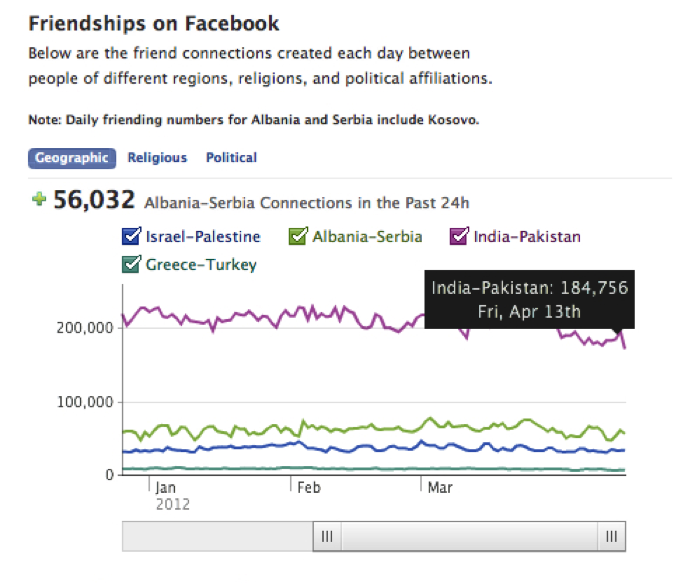
Facebook’s PeaceDot highlighted the number of daily friendships formed across conflict boundaries — Palestinians and Israelis, Indians and Pakistanis, and more.
Couchsurfing’s PeaceDot measured nightly exchanges between hosts and guests across cultural divides.
Dozens of companies, nonprofits, and communities joined — from the Dalai Lama Foundation to SourceForge.
PeaceDot made peace data visible and real-time for the first time.
The Innovation Climate of 2009
The launch came at the height of the “open collaboration” wave:
Social media platforms (Facebook, Twitter, Couchsurfing) were emerging as global infrastructures.
There was a strong cultural appetite for quantifying social impact and making invisible interactions visible.
The prevailing question: Could these platforms be designed to show us, in real-time, the extent to which people collaborate across boundaries?
PeaceDot rode that wave, pioneering the idea that peace could be measured the way clicks and likes were.
Approach: Peace Innovation Principles in Action
PeaceDot embodied the Lab’s operating principles:
Technology as a Third Social Actor
Websites and social platforms became intermediaries that made cross-boundary engagement visible.
Focus on Prosocial Behaviors
Measured friending across divides, host–guest exchanges, and other everyday behaviors of collaboration.
Experimental and Measurable Design
Each partner’s PeaceDot created live dashboards of their peace data — a running experiment in transparency.
Scalability and Replication
Over 50 organizations launched PeaceDot subdomains, creating a network effect.
Positive-Sum Outcomes
Companies showcased their peace contributions; users saw their small actions aggregated into something bigger; researchers gained a dataset of prosocial behaviors.
Results & Influence
Visibility: PeaceDot was highlighted by Facebook leaders including Mark Zuckerberg and Sheryl Sandberg.
Catalyst for PIL: The success of PeaceDot catalyzed the formal creation of the Peace Innovation Lab at Stanford.
Replication: More than 50 organizations launched their own PeaceDot pages worldwide.
Academic Value: PeaceDot seeded the development of the Peace Data Standard, later published in Frontiers in Psychology.
Legacy & Continuity
PeaceDot demonstrated that peace could be quantified, surfaced, and shared in real time. While the specific initiative waned, the principles carried forward:
Manor Labs grew directly out of PeaceDot, when Manor’s CIO wanted to create his own peace metrics.
The Peace Data Standard evolved as a rigorous framework to give individuals, companies, and investors a way to measure positive peace over time.
Today, the same principle is applied to AI: not asking how efficient it is, but how it can be designed to unlock prosocial collaboration across boundaries.
Conclusion
PeaceDot was an early prototype, a first attempt to make peace measurable at scale. It was fragile, simple, and experimental — much like Manor Labs — but it seeded a lineage of projects and frameworks that continue today.
It exemplifies the continuous tradition of the Peace Innovation Lab: experimenting with emerging technologies to measure and amplify collaboration across divides. And it anchors the continuous practice we carry forward: applying light prototyping, open collaboration, and behavior design not only to peace, but to the broader challenge of helping organizations and communities imagine, design, and innovate together.