PROJECTS & APPLIED EXPERIMENTS
Prototyping Peace
Since its founding, the Peace Innovation Lab at Stanford has used emerging technologies as testbeds for new forms of collaboration across conflict and difference boundaries. From PeaceDot to Manor Labs, from Cloud to Street to Turban Myths, these projects helped define early approaches to peace technology, civic innovation, behavior design, and peace engineering.
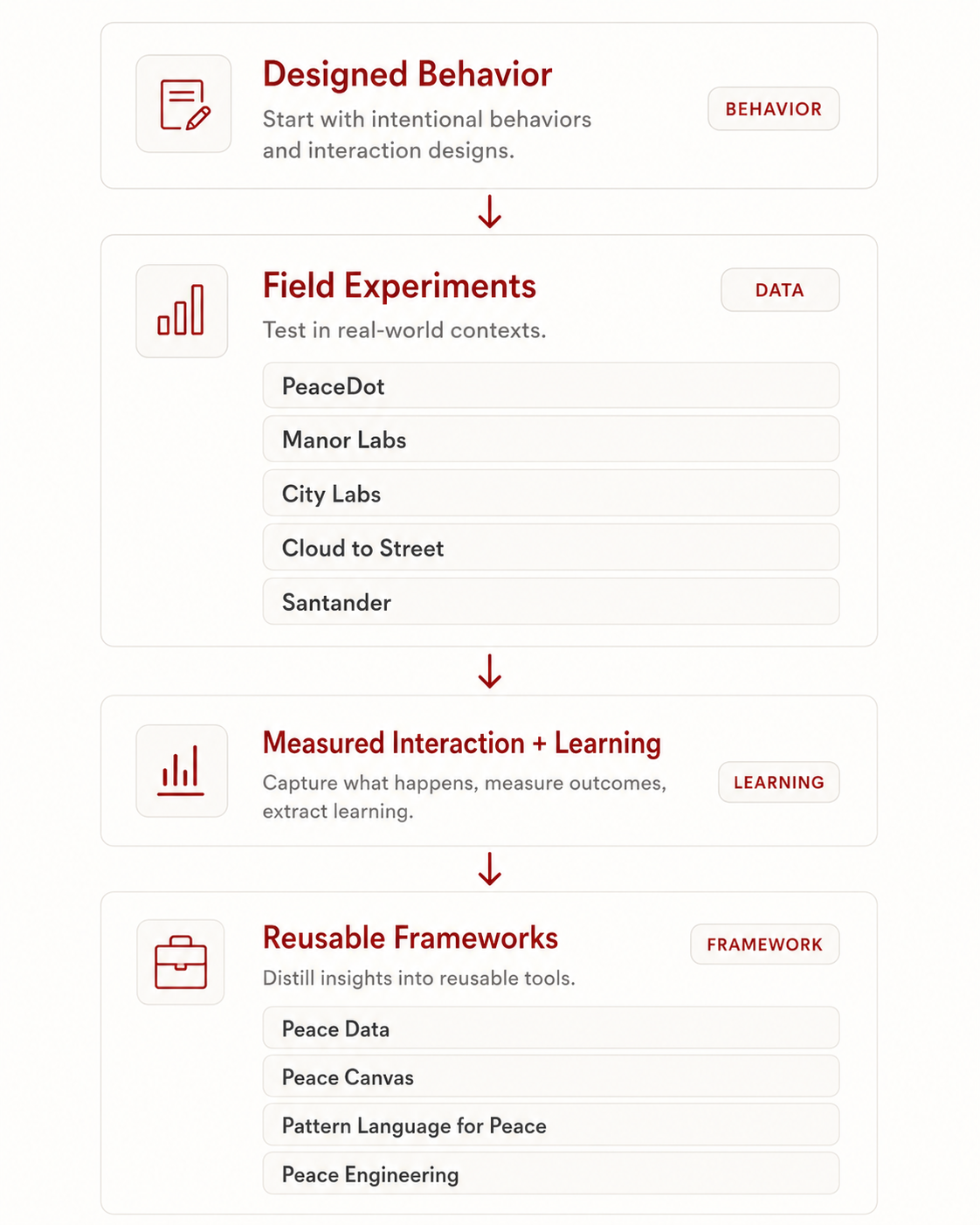
The common thread is method. PIL projects begin with observable behavior, move through rapid experimentation, generate measurable learning, and become reusable frameworks. Today, that same practice informs our work in executive education, organizational transformation, AI, and strategic foresight.
METHOD BRIDGE
How PIL Projects Become Frameworks
PIL projects are designed as applied experiments: they test specific behaviors in real-world contexts, extract measurable learning, and convert that learning into reusable methods.
FEATURED CASE STUDIES
Flagship Project
2026 | AI & STRATEGIC FORESIGHT
AI for Modeling Global Stability
A current PIL initiative exploring how AI can model cascading risks, strategic dependencies, and pathways toward more resilient global systems.
Methods
AI-assisted modeling, systems analysis, scenario design, strategic foresight, peace data reasoning.
Demonstrates
Extends Peace Innovation from local and organizational experiments to global-scale questions of resilience, cooperation, and stability.
Case Studies
2009 | FIELD EXPERIMENT
PeaceDot / peace.facebook
An early web and social media experiment that made cross-boundary friendship signals visible and measurable.
Methods
Persuasive technology, public signaling, peace metrics.
Demonstrates
Helped catalyze the lab and shaped early Peace Data thinking.
2009–11 | CIVIC INNOVATION
Manor Labs
A municipal innovation experiment using social and mobile tools to increase constructive participation between citizens and local government.
Methods
Open innovation, civic ideation, behavior design.
Demonstrates
Small cities can become testbeds for civic innovation, public-sector learning, and citizen-government collaboration.
2011 | DEMOCRACY TECH
Cloud to Street
A collaboration with Egyptian democracy activists, Stanford students, and Silicon Valley innovators during the Arab Spring.
Methods
Hackathons, civic tech, rapid prototyping.
Demonstrates
Emerging technology can support civic participation during moments of democratic transition.
2012–15 | FIELD EXPERIMENT
Peace Innovation City Labs
A series of city-scale applied experiments testing Peace Innovation methods in civic and urban contexts.
Methods
City labs, collaborative ideation, light prototyping, local partnerships, behavior design.
Demonstrates
PIL methods can move from classroom frameworks into real-world civic and urban experimentation.
2018–20 | ORG TRANSFORMATION
Santander Nordics Transformation
A multi-phase partnership using behavior design and peace innovation to strengthen innovation capacity, collaboration, and responsible value creation.
Methods
Executive workshops, behavior KPIs, prototyping, futures work.
Demonstrates
Peace Innovation methods can improve organizational collaboration, speed, and responsible business performance.
2019 | CYBER SECURITY
Unexpected PeaceTech
A behavior design cybersecurity intervention that produced prosocial learning spillovers at work and home.
Methods
Behavior Design, SnapTesting, longitudinal behavior tracking.
Demonstrates
Security training can become PeaceTech when it increases discernment, trust, and constructive information-sharing.
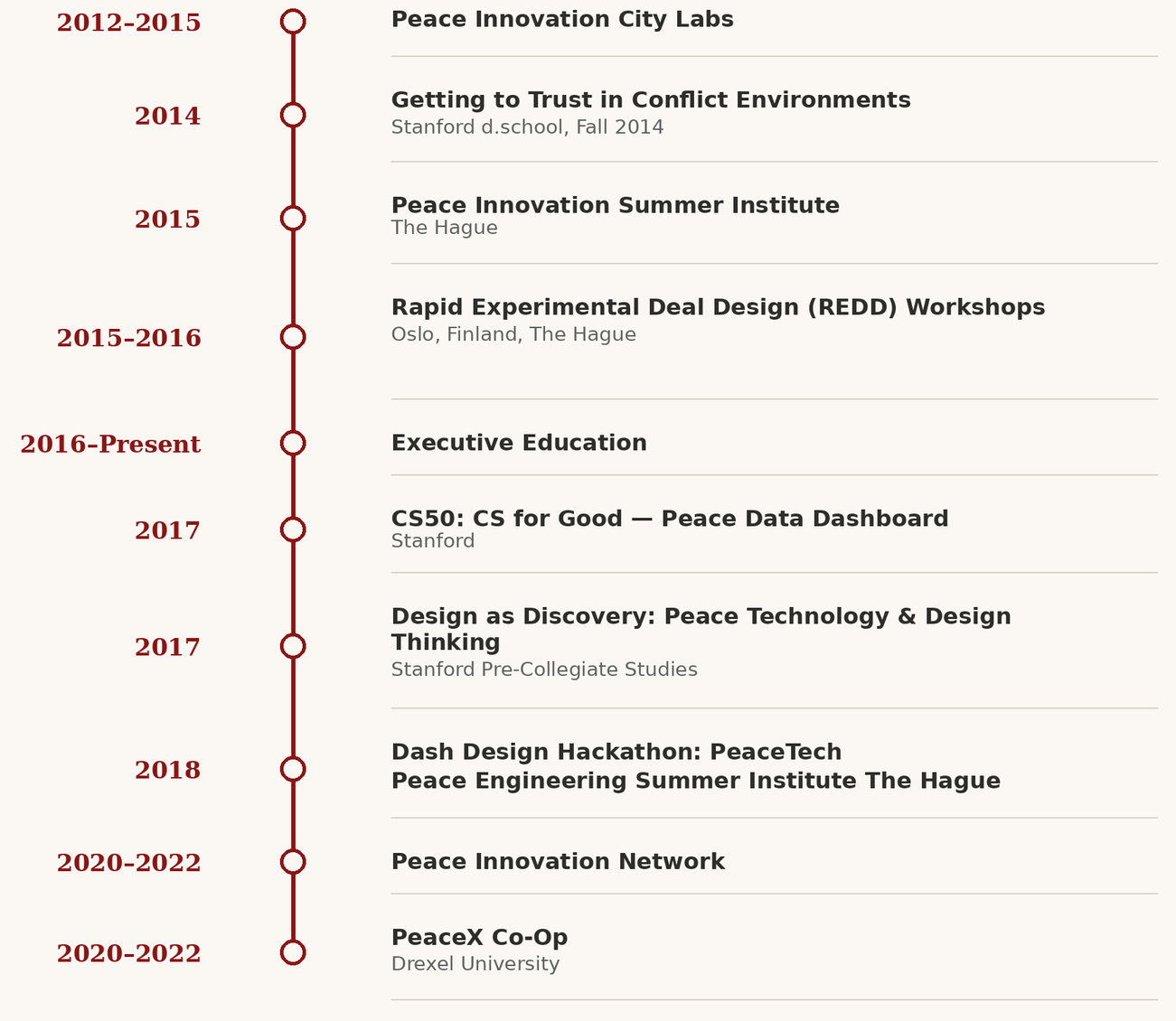
COURSES, WORKSHOPS & APPLIED LEARNING
Selected teaching and applied learning highlights